


Elsa's Blog
Shame

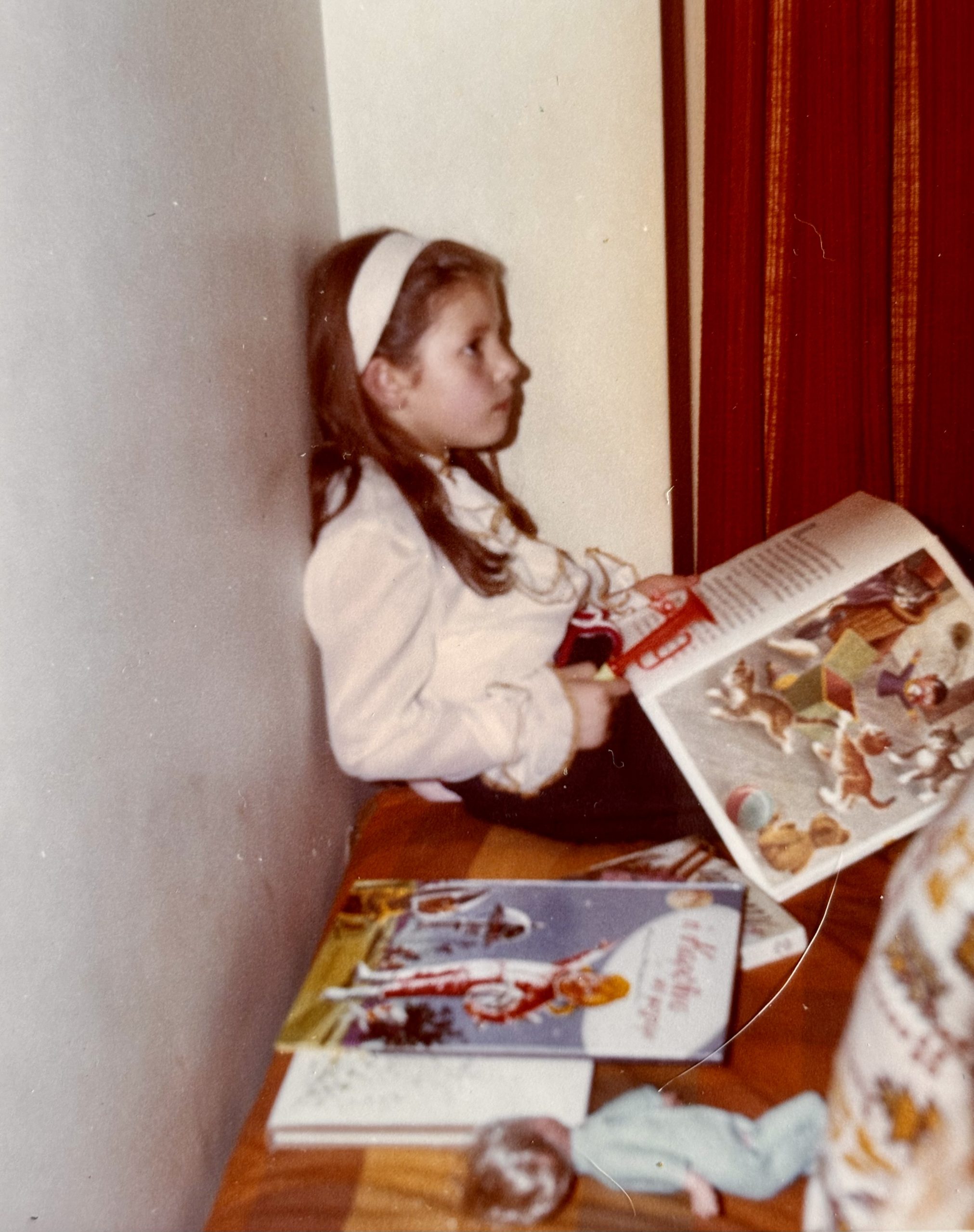
My room was separated from the living room by a glass door. There was a normal white door that led to the hallway where the other bedrooms of the house were, but there was also another door that led outside the apartment. Most likely there had once been two apartments on the floor that my father had joined together. That door was always locked, and in its center there was an icon of Saint Nicholas nailed over the peephole that looked out into the stairwell. When I was a child, I used to kneel in front of that door to say my prayers before going to sleep. Every night, besides the usual thanks for “our daily bread,” I would end my prayer with a request: “Dear God, please send me a little sibling.” I don’t know why this need was so strong, but it was a daily plea, and I remember the slight numbness I felt each time I whispered the word “sibling.” Who knows whether it was the loneliness of being an only child, the weight of carrying on my own two unhappy parents, or something else that now escapes me.
In elementary school, I had three friends: Nadia, Vaki, and Laura. Nadia had a sister, and Vaki had a brother. Laura, who lived in Kypseli—a little girl with dark hair—was also an only child, like me. So we were two and two. A wonderful, reassuring balance.
Until one day, Laura announced that her mother was going to have a baby. And if you told me I heard that moment, I would believe you. I remember it so vividly. We had just each bought a sesame bread ring from the man who sold them at school. We stood in line under the shelter, and one by one we reached into the big white sack and took one. I often waited until the line was over so I could go back and grab a handful of sesame seeds. I still love sesame. We were standing under the pine tree in the middle of the schoolyard, getting ready to play elastic band—a girls’ game that was very popular at the time—when Laura said her mother was going to have a baby. It hit me like a lightning bolt. It wasn’t only that the score was changing from 2–2 to 3–1. It was that something cracked open inside me—the first crack in my belief in the power of my prayers. God doesn’t hear me. He doesn’t care about me. I am nothing to Him. My wishes are unworthy. Or maybe I’m not saying them right? Maybe I’m not a good child? I think the emotions were so overwhelming that all I could do, with anger and pain carefully hidden, was say to Laura: “Cut it.” I held out my hand with my index and middle finger pressed together and asked her to break off our friendship, as if she had deeply betrayed me. We were in second grade. The friendship of the four girls was never the same again. A veil of melancholy had fallen over my soul.
Her mother gave birth to a baby boy a few months later. I kept praying, even more devoutly, adding details. Not only did I ask for a sibling, but I explained that I would take care of it, love it, protect it… but in vain. No one had bothered to tell me that my mother couldn’t have more children due to a medical issue.
So, since neither God nor the twelve apostles were helping, I decided to take matters into my own hands. One day, I arrived at school—not just any day, but my birthday—holding sweets, and I announced that my mother had given birth to quintuplets. That’s why I brought the sweets. As if I would let my mother be inferior to the other mothers. Quintuplets—yes, quintuplets. With chilling detail, I described that the babies were premature, that they were in incubators, three boys and two girls. I explained how they moved their little hands, how tiny they were, that they had tubes, that I had seen them yesterday—I had gone with my father, I said. We would name them Vasilis, Toni, and Christos, and the girls Bouki and Katerina. Toni and Bouki were the names of my parakeets. Vasilis and Christos were my grandfathers’ names, and Katerina my grandmother’s. My criminal lie had at least some roots in reality.
Excitement and pride accompanied that brilliant day. It was a Saturday—back then, schools were open on Saturdays too.
At noon I went home. About an hour later, the phone rang. “735038,” we used to say when we picked up—that was our number. It was my teacher, Mrs. Yiota, calling to congratulate the family on the arrival of the quintuplets. How foolish she must have been—not to think that in the middle of the dictatorship, if this were true, my mother would have been front-page news as a heroic Greek woman who had given birth to quintuplets, a global phenomenon.
My mom picked it up, I saw her get flustered, then laugh, then say I have an untamed imagination and make up stories, that I shouldn't be punished for my lie she said, she would take care of it.
I don't remember if I snatched them, but I remember my fear.
In the afternoon, we were going to a party. It was a classmate's birthday, and the whole class was invited. I was wearing a dress and a gray coat with a velvet blue collar. Buttoned all the way up. My mom wasn't talking to me, she was punishing me for my lie with her silence. I remember that feeling well.
We arrived, and as the door opened, I saw all the mothers in the living room looking at my mother and laughing uncontrollably, saying “Congratulations—quintuplets!” Ha ha ha. She laughed too. How I wished the earth would open up and swallow me—right there, in that moment, with my gray coat still on. I went into the room where the children were, sat on a small chair next to a wardrobe, staring at the wall. I never took off my coat, never unbuttoned it. I just sat there—the ultimate object of ridicule—waiting for time to pass, or rather, waiting for my whole life to pass, to wash away my shame.
I was sure everyone was looking at me, talking about me, mocking me. I created dialogues in my head, scolding myself, mocking myself. I was ashamed of existing. I found no comfort. It felt like the end of the world. There was no window anywhere. No one came to ask that seven-year-old girl, “Why? Why did you say that, sweetheart?” On her birthday, no one came to lighten the weight of her guilt, to say a single word—“I understand,” “You wanted a sibling so much that you created this story just to feel it for a little while,” “It’s okay.” Something—anything.
To acknowledge that I didn’t do it to mock anyone, that I didn’t mean harm, that I shouldn’t feel such deep shame for who I was. Everyone lies sometimes, believing they might do some good. If only someone had told me that—so I wouldn’t still be sitting here, 55 years later, with that top button fastened on the velvet collar.